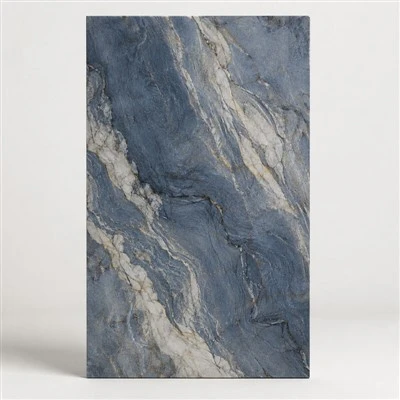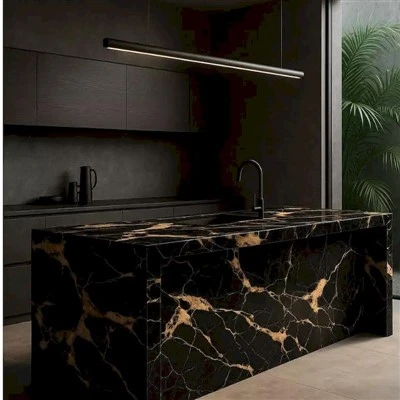
Sintered stone and industrial porcelain differ fundamentally in raw material purification, compression tonnage, and vitrification kinetics. While porcelain serves as a standard interior finish, sintered stone processed via a 30,000-ton press achieves a density exceeding 2.4 g/cm³ and a water absorption rate of < 0.05%, enabling its mechanical specification in high-load commercial engineering and high-UV exterior envelopes.
Chemical Composition and Mineral Purity
The microscopic divergence between the two materials begins at the formulation phase. Porcelain utilizes standard stoneware clays containing higher concentrations of ball clay to maintain elasticity during forming. Sintered stone requires a proprietary mix of refined, wet-ground quartz, feldspar, and silica minerals.
Sintered Stone: Features 100% natural, resin-free inorganic minerals with zero bonding polymers. Slabs integrating Full-body tech use multi-charge feeding systems to inject raw pigments directly into the mineral matrix before compaction.
Porcelain Tile: Contains a higher ratio of organic kaolinitic clays and a localized surface glaze layer, meaning pattern wear exposes the secondary clay backing.
Mechanical Compaction and Thermal Fusion Dynamics
The physical performance gap is a direct consequence of the kinetic energy applied during manufacturing. Sintered stone relies on modern continuous or discontinuous pressing lines that far exceed traditional ceramic machinery parameters.
| Engineering Property | Sintered Stone | Technical Porcelain Tile |
| Compaction Force | 30,000 to 44,000 Tons | 10,000 to 16,000 Tons |
| Specific Pressure | > 450 kg/cm² | 300 to 380 kg/cm² |
| Peak Firing Temp | 1,200°C to 1,280°C | 1,100°C to 1,180°C |
| Kiln Cycle Time | 120 to 180 Minutes | 40 to 60 Minutes |
| Internal Porosity | < 0.05% (Closed-pore) | < 0.5% (Open/Closed mixed) |
| Mohs Hardness | 6 – 7 | 5 – 6 |
The application of a 30,000-ton press under vacuum de-airing forces the raw mineral crystals into an ultra-dense packing structure. During the subsequent Sintering technology phase in the kiln, minerals undergo complete vitrification, altering the crystalline matrix to provide high Thermal shock resistance.
Application Limits and Structural Performance
The mechanical variations limit the operational environments where porcelain can safely be specified compared to sintered stone slabs.
1. Large-Format Cantilevers and Worktops
Due to its lower density and higher internal porosity, industrial porcelain retains microscopic air pockets. When cut for complex undermount sinks or L-shaped countertop configurations, porcelain is prone to stress-cracking under static loads. Sintered stone handles a flexural strength of ≥ 50 N/mm², allowing for seamless un-supported desk or counter spans.
2. High-UV and Frost-Thaw Environments
While glazed porcelain is highly resistant to standard moisture, the glaze layer can delaminate under persistent freeze-thaw cycles due to mismatched thermal expansion coefficients between the glaze and the clay base. Sintered stone features complete UV resistance and frost immunity, maintaining zero dimensional expansion across temperature differentials of -20°C to +60°C.
3. Visual Continuity with Bookmatched Designs
Porcelain patterns are predominantly surface-applied screen prints. Machining a bevel or mitered edge breaks the visual illusion. Sintered stone incorporates full-body pigmentation and high-definition matrix injection, producing synchronized Bookmatched slabs where vein patterns maintain continuity across three-dimensional spatial coordinates.
FAQ: Structural Material Selection
Why does sintered stone cost more than standard porcelain?
The pricing reflects the raw material refinement processes, the energy requirements of a continuous 30,000-ton press, and extended kiln dwell times required to fully vitrify the slab without warping or creating internal stress points.
Can porcelain diamond blades cut sintered stone?
No. Sintered stone's high density and Mohs hardness (6–7) require ultra-soft, bronze-bonded diamond tooling. Using standard porcelain blades will result in severe thermal spikes, blade glazing, and edge fragmentation.
Which material is more suitable for ventilated facade rainscreens?
Sintered stone is the industrial standard. Its lower weight-to-thickness ratio (7.5 kg/m² for 3mm formats) and complete UV resistance provide the necessary engineering margins for exterior building envelopes where porcelain risks impact shattering.