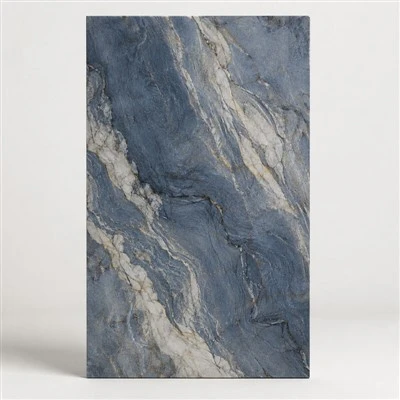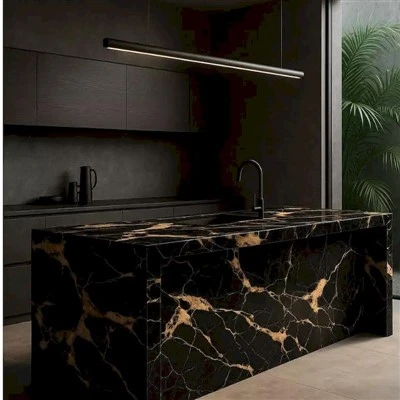
Sintered stone installation requires high-performance chemical adhesives classified under EN 12004 as C2TE S2 cementitious mortars for structural wall cladding, or reaction-resin adhesives (R2T) for non-porous backing materials. Because slabs processed via a 30,000-ton press exhibit zero mechanical porosity (water absorption < 0.05%), standard low-polymer thin-sets cannot form a reliable mechanical bond. Successful installation relies entirely on chemical adhesion through high-solid epoxies and modified polyurethanes.
Specialized Adhesive Formulations and Classifications
Selecting an adhesive depends on the structural flexural load and target environment of the installation.
| Adhesive Type | Standard Classification | Best For | Lap Shear Strength |
| Two-Component Epoxy | R2 (EN 12004) | Mitered joints, seam matching, steel backing | ≥ 4.0 MPa |
| Polyurethane Elastomer | R2T (EN 12004) | Wood substrates, vibrating environments | ≥ 3.5 MPa |
| Highly Deformable Cementitious | C2TE S2 (EN 12004) | Large-format floor, concrete walls, facades | ≥ 2.5 MPa |
For mitered edge fabrication and surface joining, two-component epoxy systems mixed with matching inorganic quartz powder ensure color matching and maintain a Mohs hardness of 6–7 across the joint line.
Bonding Protocols for Diverse Substrates
Sintered stone exhibits an extremely low thermal expansion coefficient ($6.5 \times 10^{-6} K^{-1}$). When bonded to substrates with high thermal expansion rates, the adhesive must absorb the differential shear stress.
1. Bonding to Wood Substrates (Plywood / MDF)
Wood expands and contracts based on ambient humidity. Direct application of cement-based mortar will cause bond failure.
Adhesive Requirement: Modified bi-component polyurethane or R2T epoxy.
Protocol: Sand the wood surface to remove structural oils. Apply adhesive with a 6mm V-notch trowel to guarantee 100% back-coverage, preventing dead-load deflection.
2. Bonding to Metal Substrates (Aluminum / Structural Steel)
Common in commercial elevator cabins and exterior ventilated facades where 3mm or 6mm Bookmatched slabs are deployed.
Adhesive Requirement: Isocyanate-free MS polymer or structural bi-component epoxy.
Protocol: Clean metal with isopropyl alcohol to remove anti-rust coatings. Apply structural adhesive beads vertically at 150mm intervals to facilitate ambient air curing.
Curing Times and Mechanical Stabilization
Thermal conditions dictate the cross-linking kinetics of structural adhesives. Forced structural loads before the chemical matrix achieves 90% cure will lead to permanent bond delamination.
Pot Life / Open Time: 30 to 45 minutes at 23°C. High-volume installations above 30°C reduce open time by 50%, requiring rapid tile-setting.
Initial Set Time: 4 to 6 hours. Slabs must be mechanically immobilized using suction cup leveling systems during this phase to avoid structural shifting.
Full Mechanical Load Cure: 7 days for full chemical resistance, Thermal shock resistance, and structural load-bearing capacity.
FAQ: Structural Adhesive Engineering
Can standard silicones be used to glue sintered stone countertops?
No. Standard silicone lacks the tensile lap shear strength required for load-bearing joints. It should only be used as a perimeter movement joint sealer. Structural seams must use two-component acrylic or R2 epoxy resins.
What causes joint yellowing in outdoor installations?
Standard epoxies contain aromatic polymers that degrade under ultraviolet radiation. Outdoor installations require aliphatic acrylic adhesives or specialized polyurethanes with guaranteed UV resistance to prevent joint discoloration and bond embrittlement.
Why is back-troweling mandatory for large-format slabs?
Back-troweling ensures 100% adhesive coverage. Air pockets left under a 12mm or 20mm horizontal slab create localized weak spots, which can cause the material to crack under heavy point-load impacts.