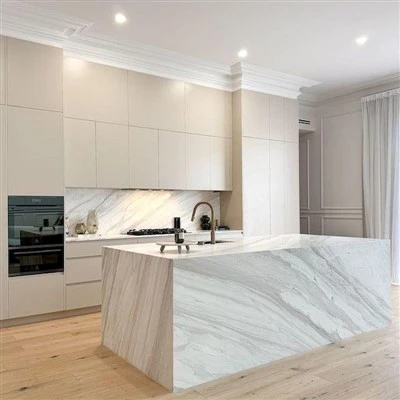
Sintered stone is a 100% natural, mineral-based architectural material that contains zero petroleum-derived resins, volatile organic compounds (VOCs), or toxic binders. Engineered via Sintering technology under a 30,000-ton press, the resulting high-density slabs are fully recyclable and chemically inert, offering an EPD-verified low-carbon alternative for green building envelopes and interior surfaces. This technical report details the material's life cycle assessment (LCA) and its direct contribution to international green building rating systems.
Chemical Composition and Raw Material Sourcing
The ecological profile of sintered stone begins at the raw material extraction phase. The composition consists exclusively of earth-minerals:
Bio-sourced Clays and Feldspars: Provide the structural base, sourced from quarries utilizing documented land-reclamation protocols.
Natural Silica and Quartz: Provide structural rigidity and a Mohs hardness of 6–7.
Inorganic Pigments: Achieve 100% Full-body tech coloration without synthetic chemical dyes.
Because the formula excludes the organic polymers and phthalates found in engineered quartz (which typically contains 7–10% resin), the material generates zero off-gassing and carries Greenguard Gold certification for indoor air quality.
Carbon Footprint and Low-Emission Manufacturing Processes
Modern manufacturing facilities operate on a closed-loop sustainability model. The production process mitigates environmental impact through specific quantifiable engineering controls:
| Sustainability Parameter | Industrial Sintered Stone Manufacturing | Traditional Ceramic Tile Production |
| Water Recycling Rate | 95% - 100% (Closed-loop filtration) | 70% - 80% |
| Pre-Consumer Recycled Content | 20% - 40% (Scrap vitrified paste reinjection) | < 15% |
| Kiln Energy Source | Methane-biogas blends / Heat recovery recovery systems | Standard natural gas / Heavy oil |
| VOC Emissions | 0.0 mg/m³ (ISO 16000) | Variable |
| End-of-Life Circularity | 100% Recyclable into aggregate | Non-recyclable landfill waste |
The heat generated during the 1,200°C firing stage is captured via heat exchangers and redirected to the spray dryers and pre-kiln drying chambers, reducing net thermal energy consumption by up to 28% compared to un-optimized lines.
Structural Longevity and End-of-Life Recycled Value
The extreme durability of sintered stone directly contributes to building lifecycle optimization. Its exceptional Thermal shock resistance and complete UV resistance prevent the atmospheric degradation, fading, and micro-cracking common in exterior rainscreens.
When a structure is decommissioned, sintered stone slabs do not require hazardous waste handling. The material can be mechanically crushed and processed into high-density inert aggregate for new concrete formulations, road substrates, or terrazzo production, ensuring a circular lifecycle.
LEED v4.1 Credit Contribution Breakdown
Specifying sintered stone allows architectural engineers to secure points under multiple Leadership in Energy and Environmental Design (LEED) categories:
Materials and Resources (MR): Contributes to Building Product Disclosure and Optimization credits through factory-specific EPDs and verified ingredient optimization (HPDs).
Indoor Environmental Quality (EQ): Qualifies for Low-Emitting Materials credits due to zero VOC content and compliance with CDPH Standard Method v1.2.
Sustainable Sites (SS): Slabs with a high Solar Reflectance Index (SRI ≥ 82 for light colors) reduce urban heat island effects when deployed as exterior paving or roof-deck finishes.
FAQ: Green Building Specifications
Does sintered stone release breathable crystalline silica during fabrication?
Like natural granite and quartz, sintered stone contains crystalline silica. However, because industrial fabrication requires continuous wet-cutting (water-jet or wet bridge saws), airborne dust is suppressed, keeping occupational exposure levels below the OSHA Permissible Exposure Limit (PEL) of 0.05 mg/m³.
How does the carbon footprint compare to natural quarried marble?
While natural stone extraction requires minimal processing heat, its high quarry waste rate (often 50–70% loss) and long-distance transport of unrefined blocks increase its carbon footprint. Sintered stone optimizes mass-to-volume transport ratios and integrates up to 40% recycled pre-consumer material.
Can 3mm sintered slabs assist in carbon reduction?
Yes. Specifying 3mm or 6mm slabs for vertical cladding reduces the raw material mass per square meter by up to 60% compared to traditional 20mm stone. This decreases transportation emissions and structural steel support requirements, lowering the building's overall embodied carbon.