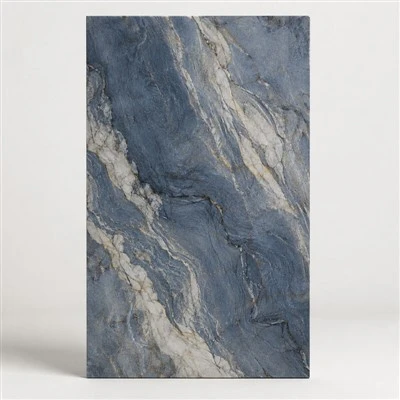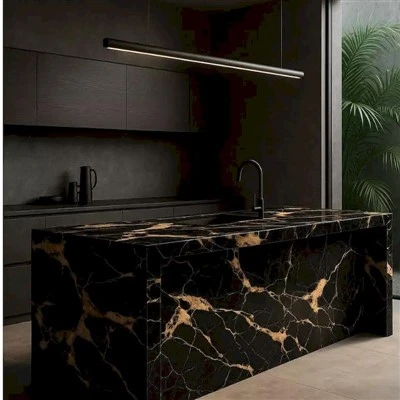
The selection of sintered stone thickness must align with the specific structural demands and load-bearing requirements of the application. While 3mm–6mm slabs are optimized for weight-sensitive vertical surfaces and furniture, 12mm–20mm formats are mandatory for high-traffic horizontal worktops and structural architectural elements.
Thickness Performance and Application Matrix
The following table summarizes the recommended applications based on material thickness and mass.
| Thickness | Weight (approx.) | Primary Application | Fabrication Requirement |
| 3mm | 7.5 kg/m² | Cabinetry, wall cladding, door skins | Fiber-glass mesh backing required |
| 6mm | 15 kg/m² | Interior/Exterior facades, furniture | CNC precision for mitering |
| 12mm | 30 kg/m² | Kitchen countertops, vanity tops | Substrate support mandatory |
| 20mm | 50 kg/m² | Industrial worktops, structural desks | Specialized heavy-duty lifting gear |
3mm and 6mm: Lightweight Vertical Solutions
Sintered stone at 3mm and 6mm provides a significant reduction in structural dead load, critical for high-rise exterior rainscreens and interior wall renovation. Due to the inherent tension generated by Sintering technology during the cooling phase, slabs under 6mm require factory-applied fiber-glass reinforcement to prevent handling fractures.
UV Resistance: Maintains stability on exterior envelopes without requiring heavy structural steel frames.
Fabrication: Must be cut using high-speed water-jet systems to mitigate edge stress.
Procurement Alert: Ensure all 3mm–6mm orders specify reinforcement mesh standards to avoid on-site breakage. Request a batch testing report to verify tensile strength or Download 2026 Slab Catalog for full project specifications.
12mm and 20mm: Structural Horizontal Applications
Horizontal surfaces subjected to heavy static loads (e.g., kitchen islands, commercial counters) require a minimum thickness of 12mm. While these slabs exhibit high Mohs hardness (6–7), they are susceptible to point-load impact stress if not supported by an engineered substrate.
Substrate Requirements: For 12mm slabs, a continuous support (marine-grade plywood or aluminum honeycomb) is necessary for spans exceeding 600mm.
Thermal Shock Resistance: 20mm slabs offer superior mass for heat dissipation, making them the standard for industrial kitchens where direct contact with heat sources is frequent.
Edge Profiling: Full-body tech is critical at 12mm–20mm to ensure vein continuity on exposed mitered or bullnose edges.
Fabrication and Handling Complexity
Fabrication difficulty increases exponentially with thickness. A 30,000-ton press produces slabs with high internal density, which makes dry cutting difficult and prone to edge chipping.
3mm/6mm: Extremely fragile during transit; requires A-frame transport with full-surface backing.
12mm: Standard for professional fabricators; compatible with standard bridge saws using sintered-rated diamond blades.
20mm: Requires specialized hydraulic lifting gear and industrial CNC equipment for accurate edge detailing and sink cutouts.
FAQ: Technical Specification Insights
Can 6mm slabs be used for countertops?
No. 6mm slabs lack the structural mass to withstand impact loads and concentrated weight. They must be laminated to a substrate or used exclusively for non-impact vertical surfaces to prevent structural failure.
Why does 20mm sintered stone cost more than 12mm?
The cost reflects the increased raw material volume, longer kiln dwell times, and the energy required to ensure uniform internal vitrification during the sintering process. It also incurs higher logistics costs due to the weight-to-shipping-space ratio.
Is substrate required for all sintered stone installations?
It depends on the application. Vertical cladding often uses mechanical clips. However, all horizontal surfaces (countertops, workbenches) require a structural substrate to mitigate deflection, regardless of the slab thickness selected.