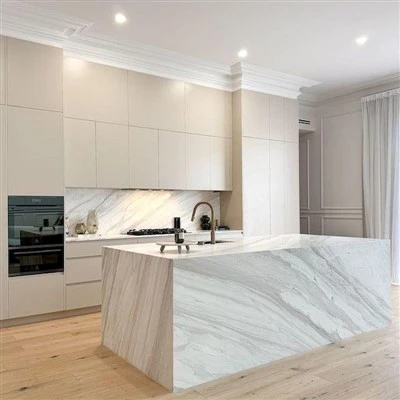
Sintered stone countertop fabrication requires strict adherence to mechanical tension-release protocols and calibrated cutting parameters to prevent material fracturing. Slabs processed via a 30,000-ton press possess high internal density and residual stress that must be systematically managed during bridge saw and CNC operations. Implementing specialized diamond tooling, correct RPM settings, and high-volume water cooling ensures clean edge finishes and eliminates processing waste.
Tool Selection: Diamond Blades and Core Drills
Standard blades designed for quartz or granite will cause edge chipping and catastrophic slab failure due to binding. Sintered stone requires continuous-rim or closely segmented diamond blades featuring a soft, bronze-bonded matrix designed to expose fresh diamond grit continuously under high-density wear.
| Tooling Parameter | Specification for 12mm Slabs | Specification for 20mm Slabs |
| Blade Matrix Bond | Ultra-soft / Bronze-bonded | Soft-alloy bonded |
| Segment Height | 10 mm – 12 mm | 10 mm – 12 mm |
| Core Drill Type | Thin-wall diamond crown | Thin-wall diamond crown |
| Peripheral Drill Speed | 1,500 – 2,000 RPM | 1,200 – 1,500 RPM |
Bridge Saw and Water-Jet Calibration Parameters
The feeding speed must be dynamically adjusted depending on whether the blade is entering, traveling through, or exiting the slab. Linear cutting speeds must be reduced by 50% during the first and last 100mm of the cut pass.
Kinematic and Operational Settings for a 400mm Blade:
Straight Linear Feed Rate (12mm Slab): 1.2 – 1.8 meters per minute.
Straight Linear Feed Rate (20mm Slab): 0.8 – 1.2 meters per minute.
Miter Cut (45°) Feed Rate: Reduce standard straight-cut feed speed by 40% to 50%.
Rotational Speed (RPM): 1,600 – 1,900 RPM based on peripheral blade velocity calculations.
Coolant Flow Volume: Minimum 35 liters per minute delivered directly to the cutting physics zone via dual-sided nozzles. Water must be clean and unfiltered by recycling flocculants that contain abrasive mineral fines.
Cutting Speed Profile: [Slab Entry: 50% Speed] ---> [Main Body Cut: 100% Speed] ---> [Slab Exit: 50% Speed]
Eliminating Internal Residual Stress to Prevent Cracking
Because Sintering technology vitrifies the minerals into a homogeneous structure, internal kinetic tensions exist within the perimeter raw edges of unrectified slabs. Fabricators must execute a mandatory stress-relief sequence before executing any finished countertop cutouts.
Perimeter Trimming: Remove a minimum of 20mm from all four raw edges of the slab. This releases the high-tension boundary zone created during the cooling phase of production.
Internal Corner Radius Protocol: Square internal cutouts are strictly prohibited. All internal corners for hobs, undermount sinks, or L-shaped configurations must be pre-drilled with a minimum radius of 5mm (10mm diameter hole). This circular geometry dissipates structural load and eliminates stress concentration points that cause cracking during transport or thermal shifting.
Cutout Proximity: Maintain a minimum distance of 50mm between any cutout edge and the outer perimeter of the fabricated countertop.
Material Handling and Substrate Requirements
Slabs display high rigidity but are vulnerable to flexural cracking during vertical-to-horizontal transport. Fabricators must utilize rigid aluminum-frame suction cup bars for transport to CNC beds. For the final installation, 12mm countertops require flat, continuous structural support-such as high-density polyurethane foam strips or marine-grade plywood substrates-to ensure uniform distribution of static loads and protect the material's inherent Thermal shock resistance from localized structural flexing.
FAQ: Structural Fabrication Engineering
Why do blades deflect or spark when cutting sintered stone?
Deflection indicates excessive feed speed or a blade matrix that is too hard, causing the diamonds to glaze over. Sintered stone requires a soft-bond matrix that erodes quickly, exposing new cutting edges to handle the high density produced by a 30,000-ton press.
Can I plunge-cut directly into a slab with a bridge saw?
No. Direct plunge cutting creates localized kinetic stress concentration. Fabricators must pre-drill the corners of the cutout area using a thin-wall core drill before initiating straight-line saw passes between the holes.
Does full-body tech affect cutting parameters?
Slabs utilizing Full-body tech maintain highly uniform mineral distribution throughout the core. This consistency reduces unpredictable hard spots common in natural stone, allowing for uniform feed rates throughout the entire linear cutting pass.