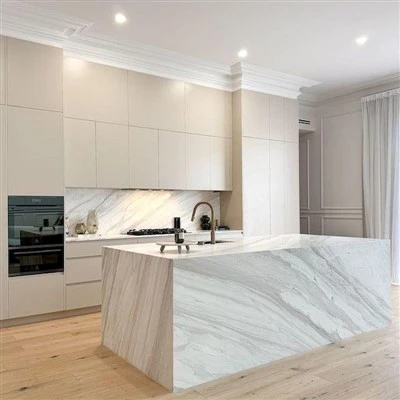
Full-body sintered stone is an advanced architectural material where the color, grain, and vein structure penetrate through the entire thickness of the slab via synchronous mineral layering. Surface-printed alternatives rely on an inkjet graphic layer applied to a monochrome base, creating a visible division between the surface pattern and the exposed edge during fabrication. For high-end commercial projects requiring intricate edge profiling, full-body composition is mandatory to maintain aesthetic continuity.
Structural Differences: Full-Body Tech vs. Surface Printing
The distinction between these two categories lies within the feeding and compacting stages of production before entering the 30,000-ton press.
| Technical Parameter | Full-Body Tech Sintered Stone | Surface-Printed Sintered Stone |
| Through-Body Composition | Continuous mineral mix matching surface veins | Solid color base (typically white, grey, or beige) |
| Pattern Depth | 100% of slab thickness (3mm - 20mm) | Surface layer restricted to 0.2mm - 0.5mm |
| Visible Edge After Cutting | Identical to the surface pattern | Plain solid color without vein structure |
| Aesthetic Retention | Immune to edge chipping or deep surface scratches | Scratches expose the contrasting base color |
| Manufacturing Requirement | Multi-charge system with dry mineral injectors | Single-charge system with standard digital inkjet |
Edge Aesthetics and Processing Performance
When specifying materials for high-exposure architectural elements, the slab edge is a primary quality indicator. Surface-printed slabs require mitered edge fabrication (45-degree joints) to conceal the plain core matrix. If a project specifies a drop apron, bullnose, or chamfered profile on a counter, the unpatterned base of a surface-printed slab becomes visible.
Full-body material uses synchronized powder deposition. The veins visible on the surface are physically present inside the core. When the slab is cut, routed, or engraved via CNC water-jet machinery, the exposed profile mimics natural stone blocks. This is critical for creating realistic Bookmatched slabs on waterfall islands and structural columns where three-dimensional vein continuity is required.
Selection Strategy for Commercial Procurement
When to Specify Full-Body Sintered Stone:
Horizontal Countertops: Kitchen islands, reception desks, and laboratory benches where undermount sinks expose a raw 12mm or 20mm profile.
High-Traffic Flooring: Commercial stairs and public concourses where foot traffic causes abrasive wear. Sintered stone has a Mohs hardness of 6–7; a full-body composition ensures that even minor abrasions over a 20-year lifespan will not reveal a different base color.
Complex Architecture: Columns, exterior steps, and custom furniture requiring exposed, polished radiuses.
When Surface-Printed Sintered Stone is Acceptable:
Large-Scale Wall Cladding: Vertical installations utilizing thin formats (3mm or 6mm) where edges are concealed by metal tracks or corner profiles.
Cabinet Door Skins: Applications where the material is flush-mounted within an aluminum frame, hiding the perimeter.
Both manufacturing methods yield excellent Thermal shock resistance and UV resistance because they utilize the same foundational Sintering technology and inorganic minerals. However, full-body tech represents the industrial standard for premium architectural applications.
FAQ: Material Grade & Technical Verification
How can I visually identify full-body tech at the warehouse?
Examine the side profile of the unpolished slab. In a true full-body slab, the major vein lines and color shifts seen on the surface will continue down the side of the material in a solid, uninterrupted transition.
Does full-body tech affect the mechanical strength of the slab?
Yes. The distribution of distinct mineral types throughout the core during the 30,000-ton press stage creates a more uniform internal tension, reducing the risk of directional cracking when cutting complex internal cutouts for hobs and sinks.
Why is surface-printed material more common in 3mm thicknesses?
Thin 3mm slabs are primarily used for flat vertical cladding. Because the edge profile is rarely exposed in these applications, full-body mineral injection is technically unnecessary, allowing surface printing to be a more cost-effective alternative.