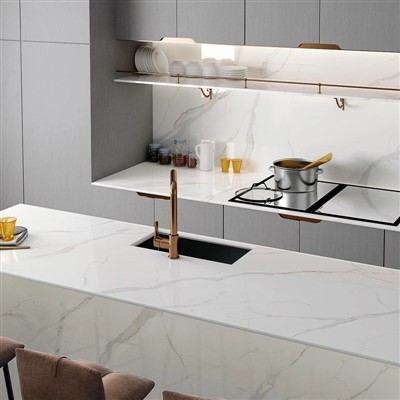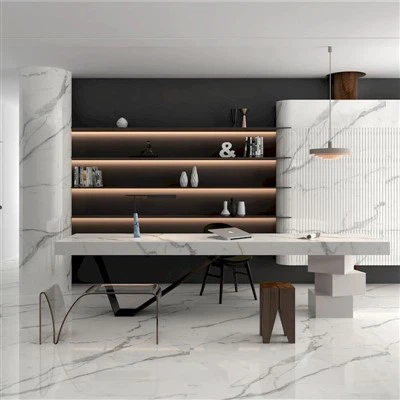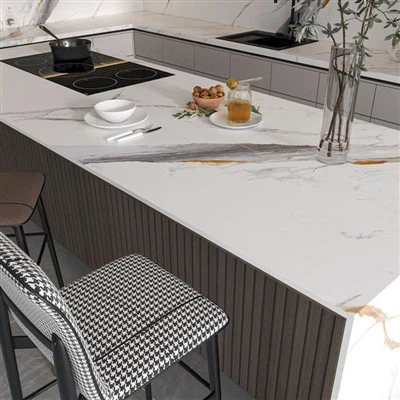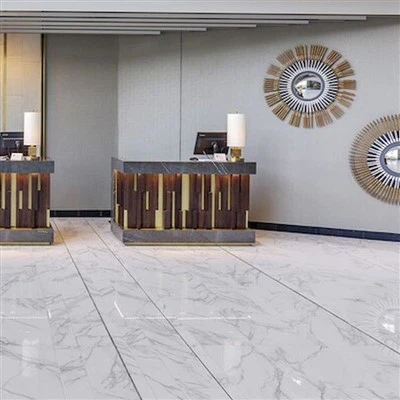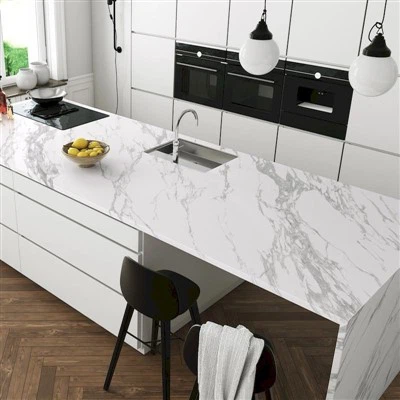
Bookmatched sintered stone refers to the structural mirroring or sequential alignment of mineral veins across adjacent slabs to form a continuous pattern. Engineered via high-precision digital inkjet systems and a 30,000-ton press, this technique allows large-scale commercial project surfaces to maintain geometric visual continuity without the unpredictability and structural fissures found in bookmatched natural marble.
Mechanics of Continuous Vein Stone and Bookmatching
The production of Bookmatched slabs relies on advanced Sintering technology coupled with 12-channel high-definition digital rendering. Unlike natural quarried stone, where slicing a block yields limited mirrored pairs, engineered sintered stone achieves precise pattern duplication across standardized batches.
Architectural layouts generally utilize two primary formats:
True Bookmatch (A/B Mirroring): Slab B is printed as an exact horizontal or vertical mirror image of Slab A.
Endless Veining (Continuous Flow): Slabs are printed in a repeating sequential pattern (A, B, C, D) where the vein exits the right boundary of one slab and enters the left boundary of the next.
| Parameter | Engineered Bookmatch | Natural Stone Bookmatch |
| Pattern Alignment Accuracy | Within ±1.0 mm | Variable (Subject to geological shifting) |
| Slab Thickness Options | 3mm, 6mm, 12mm, 20mm | Typically limited to ≥20mm |
| Structural Integrity | Zero internal fissures; Uniform density | Prone to natural hairline cracks along veins |
| Color Consistency | Controlled ΔE < 0.5 across batches | Variable due to mineral oxidation |
Installation Protocols for Optimal Optical Alignment
Achieving a flawless continuous vein appearance requires strict adherence to stone-setting tolerances. The high density and Mohs hardness (6–7) of sintered stone mean that poor structural preparation cannot be corrected via post-installation grinding.
1. Substrate Deflection Limits
Before applying adhesives, the concrete or aluminum framing substrate must be verified for flatness. Max allowable deflection must not exceed L/360 under full structural load.
2. Joint Width and Grout Calibration
To maintain pattern continuity, joints should be stabilized between 1.5mm and 2.0mm. Slabs must not be butt-jointed without a gap; structural expansion requires a minimum joint. Use color-matched epoxy resins formulated with the same refractive index as the slab matrix to render the seam optically invisible at a distance of 1.0 meter.
3. Leveling Systems
Mechanical leveling clips must be placed every 400mm along the slab edges during the setting phase. This mitigates lippage (vertical misalignment between adjacent edges), which distorts the continuous vein trajectory.

Dominant Commercial Applications
High-Impact Feature Walls and Facades
Due to its 100% UV resistance and Thermal shock resistance, bookmatched sintered stone is heavily specified for exterior ventilated cladding and high-exposure lobby feature walls. The inorganic mineral pigments are immune to solar fading, preserving the high-contrast vein definition indefinitely.
Commercial Hospitality Surfaces
Large-format 12mm and 20mm continuous vein slabs are utilized for reception desks and island countertops. Utilizing Full-body tech allows fabricators to create mitered drop-apron edges where the pattern wraps vertically down the cabinet gable without graphical interruption.
FAQ: Technical Specification & Alignment
What is the maximum pattern alignment tolerance for bookmatched slabs?
Industrial production standards dictate a maximum geometric deviation of ±1.0mm at the intersecting boundary lines. Fabricators must dry-lay and pre-align the panels in the workshop before onsite adhesive application to verify line convergence.
Can 6mm bookmatched slabs be used for elevator interiors?
Yes. At 15 kg/m², 6mm slabs drastically reduce structural cabin weight compared to 20mm natural stone, allowing compliance with elevator load ratings while maintaining premium continuous vein aesthetics.
How do I specify sequencing for an endless vein project?
When submitting a procurement order, provide the exact layout elevation and specify the required sequence codes (e.g., Sequence A-B-C-A). Slabs are tracked, crated, and shipped sequentially from the kiln line to match this order.