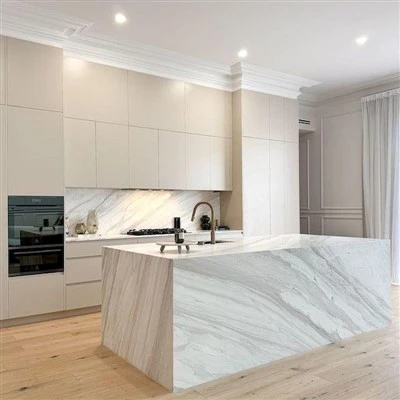
Sintered stone is an inorganic architectural material engineered through 30,000-ton vacuum pressing and 1,200°C sintering, offering absolute thermal immunity and UV stability. While quartz remains a viable interior solution, its resin-based composition (7-10% polymer) limits its performance in high-heat environments and outdoor applications where sintered stone provides a zero-maintenance alternative.
Technical Performance Matrix: Sintered Stone vs. Quartz
The following data represents laboratory-tested performance metrics for 12mm and 20mm slabs.
| Performance Metric | Sintered Stone | Engineered Quartz |
| Composition | 100% Natural Minerals | 90-93% Quartz + 7-10% Resin |
| Heat Resistance | Up to 1,200°C (Non-combustible) | Approx. 150°C (Risk of resin scorching) |
| Water Absorption | < 0.05% | < 0.1% |
| Mohs Hardness | 6 - 7 | 6 - 7 |
| UV Resistance | 100% (Inorganic pigments) | Low (Resin yellows over time) |
| Chemical Resistance | Resistant to acids and alkalis | Susceptible to strong solvents |
| VOC Emissions | Zero | Variable (Depending on resin) |
Thermal Shock Resistance and Surface Integrity
A primary driver for the 2026 shift toward sintered stone in commercial kitchens and laboratory surfaces is Thermal Shock Resistance. Because sintered stone is produced via Sintering technology at extreme temperatures, it can withstand direct contact with hot cookware without structural failure. In contrast, the resin binders in quartz undergo thermal expansion at approximately 150°C, which can lead to permanent surface discoloration or cracking when exposed to rapid temperature changes.
Industrial Procurement Action: For high-volume projects requiring laboratory-grade durability, verifying the material's thermal limits is essential. Download our 2026 Slab Catalog or contact our technical department for a batch testing report.
Outdoor Application and UV Stability
Quartz is technically restricted to interior use. Ultraviolet (UV) exposure triggers a chemical reaction in the petroleum-based resins used in quartz, resulting in structural brittleness and "yellowing" of the surface. Sintered stone utilizes Full-body tech with inorganic pigments that are physically fused during the 30,000-ton press process. This ensures 100% color fastness and structural integrity for exterior facades, rainscreens, and outdoor hospitality surfaces.
Maintenance and Long-term ROI Analysis
The maintenance cost of sintered stone is lower in high-traffic B2B environments. Its non-porous surface (absorption < 0.05%) eliminates the need for chemical sealants. While quartz is also non-porous, its susceptibility to chemical "etching" from heavy-duty industrial cleaners makes sintered stone the preferred choice for medical and food-processing facilities where hygiene protocols are rigorous.
Sintered Stone: No sealing required; resistant to bleach, ammonia, and high-pressure steam cleaning.
Quartz: Requires pH-neutral cleaners; avoid prolonged exposure to concentrated chemicals to prevent resin degradation.
Engineering Conclusion for Large-Scale Procurement
For projects limited to residential interior flooring with stable temperatures, quartz remains a cost-effective option. However, for 2026 specifications involving outdoor cladding, heavy-duty commercial kitchens, or high-UV environments, sintered stone is the technical standard.
FAQ: Technical Procurement Insights
Can sintered stone be repaired if chipped?
Repairing sintered stone is difficult due to its extreme density and tension. While resin fillers exist, they often fail to match the texture and light refraction of the original slab. High-traffic areas should utilize mitered edges to minimize chip risk during operation.
Is sintered stone harder to fabricate than quartz?
Yes. Due to its high Mohs hardness and internal tension, it requires water-jet cutting or specialized diamond blades and CNC machinery. Fabricators must follow specific tension-release protocols to prevent cracking during the cutting process.
Why is sintered stone considered more sustainable?
Sintered stone is 100% recyclable and contains no petroleum-based resins or VOC-emitting binders. Its production uses natural minerals and closed-loop water systems, meeting the rigorous ESG requirements of modern large-scale construction contracts.